Tweaking acrylic paint thickening isn’t just bumping up viscosity values. Poor rheological control causes two common headaches: pigment settling in storage and sagging and poor levelling once painters apply the coating.
Formulators who have utilized ASE, HASE, and HEUR to formulate water-based acrylic paints are likely well aware that these three rheology modifiers can alter the flow behavior of the pigments through rheological control—and can even simultaneously enhance their suspension, storage stability, and application performance.
Why is it Necessary to Thicken Acrylic Paints?
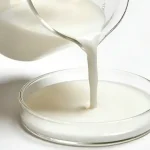
Acrylic emulsion is a highly fluid, milk-like liquid. If left unthickened, the following problems may arise:
- Sagging occurs during brush application.
- Runs develop during spray application.
- Splattering occurs during roller application.
- This results in uneven film thickness.
- Issues such as stratification arise during storage.
Furthermore, the occurrence of these issues is not solely a matter of thickening; it fundamentally underscores the critical need for comprehensive rheological control.

How ASE, HASE, and HEUR Control Rheology
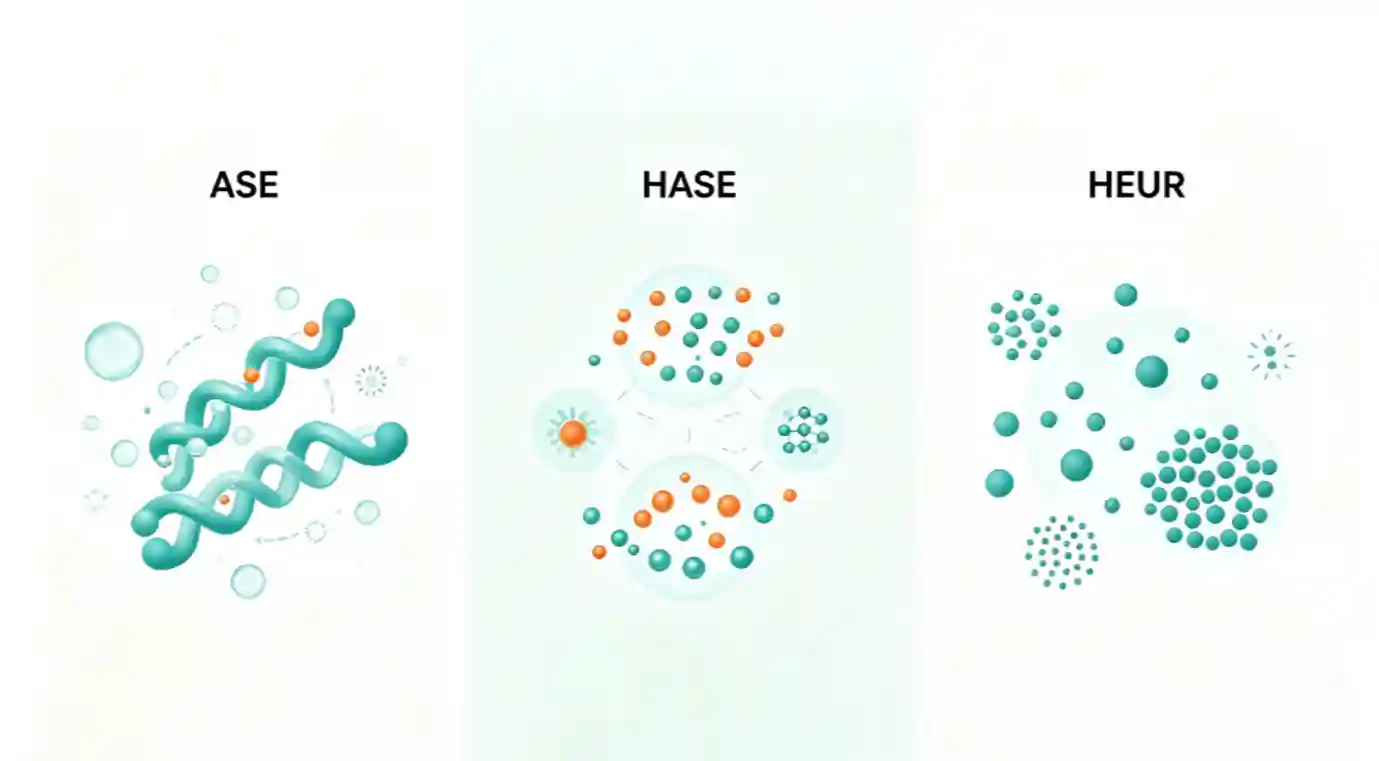
ASE primarily swells after neutralization, causing the system’s viscosity to be dominated by the low-shear region—for instance, in terms of storage stability and resistance to settling.
HASE possesses both alkali-swelling and hydrophobic association capabilities, providing balanced rheological properties across both low- and medium-shear ranges.
HEUR achieves thickening through transient hydrophobic associations with latex particles, thereby enhancing high-shear viscosity and application performance.
Acrylic Paint Application Formulation Solutions
ASE Acrylic Thickeners
Suitable for acrylic paint applications including: economical latex paints, primers, architectural paints, and cost-sensitive formulations.
Key Advantages: ASE offers relatively low cost, high thickening efficiency, ease of use, and makes a significant contribution to low-shear viscosity.
Disadvantages: poor leveling properties, average splash resistance, sensitivity to electrolytes, and a tendency toward excessive pseudoplasticity.
Typical Dosage: 0.2%–1.0%
Typical Final pH: 8.0–9.5
HASE Acrylic Thickeners
Suitable for acrylic paint applications including: mid-to-high-end latex paints, exterior wall coatings, semi-gloss paints, and matte paints.
Key Advantages: HASE features superior sag resistance, maintains stable viscosity after can opening, offers better leveling properties than ASE, provides better suspension performance than HEUR, and generally offers a high cost-performance ratio.
Disadvantages: The primary drawbacks are a higher cost than ASE and slightly inferior leveling properties compared to HEUR.
Typical Dosage: 0.2%–1.0%
HEUR Acrylic Thickeners
Applicable acrylic paint systems include premium interior and exterior wall paints, high-gloss paints, and high-performance industrial acrylic coatings.
Key Advantages: HEUR rheology modifiers provide excellent leveling properties, resulting in fewer brush marks in the finished application, enhanced film fullness, superior gloss retention, outstanding sprayability, and an optimal overall film appearance.
Disadvantages: Its advantages are many, but its cost is the highest, and it is sensitive to surfactants.
Typical Dosage: 0.1%–0.7%
Quick Selection Feature Overview
| Property | ASE | HASE | HEUR |
| Thickening Mechanism | Swelling | Swelling + Association | Association |
| Low Shear Viscosity | Excellent | Excellent | Moderate |
| High Shear Viscosity | Poor | Good | Excellent |
| Leveling | Poor | Good | Excellent |
| Sag Resistance | Moderate | Moderate | Good |
| Cost | Low | Medium | High |
Synergistic Application Offers Some Unexpected Benefits!
ASE + HASE provide low-cost and excellent application performance.
HEC + HASE offers balanced application properties and superior sag resistance.
HEUR + HASE delivers excellent leveling, a smooth brushing feel, and a superior film appearance.
Common Pitfalls in the Thickening Process of Acrylic Paints
Blindly Increasing Thickening Agents
Many formulation engineers think that the paint is too thin. The first reaction might be “Add more thickening agents.”
However, adding too much not only increases the cost but also brings some side effects:
- It is prone to leaving brush marks, roller marks, or orange-peel textures.
- It is particularly difficult to brush or roll, and it feels heavy.
- After the paint film dries, it is prone to appearing with pinholes and bubbles.
The correct approach: Adjust the flow rate based on the construction method instead of blindly increasing the amount. The fluidity required for brushing and spraying is completely different, and the amount should be added accordingly.

Ignored the Influence of the pH Value
Thickeners like HASE (alkali-swelling type) can only “thicken” at specific pH values.
If the paint’s pH is too high or too low, the thickener will not function, and adding more would be a waste.
Correct procedure: Before measuring viscosity, first measure the pH. Ensure the pigment’s pH is precisely within the thickening agent’s optimal working range.
Choosing the Wrong Type of Paint Thickeners
Different thickening agents produce different rheological effects.
- ASE governs low shear.
- HASE governs low to medium shear.
- HEUR governs medium to high shear.
Sometimes, even with only one thickening agent, it is difficult to meet both requirements: “no separation during storage” and “smooth application during brushing.”
The correct approach: Work together as a team. Usually, different types of thickening agents need to be used in combination to achieve a perfect balance in storage, application, and paint appearance.

No Compatibility Test is Conducted.
In actual production, a thickener is merely one component of a paint formulation; it reacts chemically with other constituents, such as emulsions, color pastes, and various additives.
If no tests are conducted and large-scale production is carried out directly, problems such as lump formation, layering, or thickening failure may occur.
The correct approach: Start by conducting experiments with a small sample. Make full use of the supplier’s free samples and conduct laboratory compatibility verification of the formula. Once it is confirmed to be fine, proceed with mass production to save time and money.
FAQs
Why is rheological property more important than viscosity in the formulation of paints?
Because two paints with the same viscosity may have completely different application properties, anti-precipitation capabilities, and leveling effects.
Why is HEUR more expensive than ASE or HASE?
The manufacturing process for HEUR is more complex. Furthermore, it delivers superior leveling properties, application performance, and final film appearance, which typically results in a higher cost.
Why do laboratory test results differ from mass production results during the manufacture of acrylic paints?
This is because, during scale-up, factors such as mixing equipment, shear conditions, and the sequence of additive introduction all influence the final rheological properties.
Why do acrylic coatings exhibit sagging?
The primary reason is inadequate rheological control; the coating lacks the structural integrity to support the weight of the wet paint film after application.
How do I choose the right thickener for my formulation?
It requires comprehensive consideration of cost, application method, target viscosity, leveling requirements, and storage stability.
Does pigment settling necessarily indicate an issue with the thickener?
Not necessarily. The choice of dispersant, pigment particle size, filler ratio, and density differences within the system can all influence settling behavior.
Choose a Reliable Acrylic Thickener Manufacturer

The technical team at Celotech Ruico can assist you in enhancing your product’s sag resistance, optimizing viscosity and rheological properties, reducing formulation costs, and providing complementary product testing. We invite you to contact us to obtain the customized formulation solution best suited to your needs.