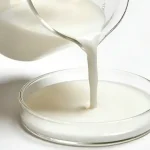
The choice of film-forming material is a key factor in whether an elastomeric roof coating (ERC) can maintain good performance over the long term. Acrylic emulsions provide good weather resistance, flexibility, and adhesion to coating films, and they are widely used in elastomeric roof coatings.

Why Acrylic Emulsions Matter in Elastomeric Roof Coatings Formulations
Compared with ordinary building coatings, elastomeric roof coatings usually need to withstand the adverse effects and damage caused by the harsh outdoor environment for a long time. Therefore, their main functions lie in waterproofing, sealing, and protecting the roof.
This means that a roof coating’s performance immediately after application does not necessarily guarantee long-term effectiveness. What matters is the coating’s ability to remain intact and continue providing waterproofing and protection over time. This is one reason emulsion polymers are a key raw material for elastomeric roof coatings.
5 Key Performance Benefits of Acrylic Emulsions in Elastomeric Roof Coating Formulations

Enhance Flexibility and Crack Resistance
During long-term use, the roof substrate may undergo a certain degree of expansion, contraction, or slight displacement. If the coating film cannot adapt to these changes, cracks may gradually form. Acrylic emulsion can help the coating film enhance its flexibility and elongation properties, enabling it to withstand a certain degree of substrate deformation.
Flexibility is not always the higher the better. If the coating film is too soft, it will affect hardness, stain resistance, and service life. A sufficient elongation capacity, combined with matching flexibility with strength, is best.
Better Weather and UV Resistance
When used in outdoor building coatings, acrylic emulsions can help the coating maintain good elasticity and integrity. After being exposed to long-term sunlight, rain, and temperature changes, the coating is less likely to show obvious fading, cracking, and aging and can provide longer-term protection for the roof.
Improve Water Resistance and Film Integrity
The first consideration for roof coatings is waterproofing. After the acrylic emulsion dries, it forms a continuous protective film on the surface, helping to prevent water from entering the substrate. For roof surfaces made of concrete or mortar that are frequently exposed to rain, the integrity of the coating film and its water-resistance stability will directly affect the performance of the coating.
However, the final coating’s waterproof performance is not determined by the emulsion alone. Pigments and fillers, additives, formula ratio, film thickness, and construction conditions all affect the final results. Therefore, the evaluation of emulsions should not only look at the water resistance data of the emulsion itself but should also be put into the actual formula for testing. A good emulsion is the basis; real waterproofing performance depends on the final coating film.
High Compatibility with Substrate Adhesion
In actual project applications, elastic roof coatings may encounter concrete, mortar, metal, old coatings, or other different substrates. The roughness, water absorption, and cleanliness of the substrate surface may also vary.
The coating not only needs to have stable performance itself but also needs to have good adhesion with the substrate. Appropriate acrylic emulsion can provide a good adhesion foundation for the coating and help reduce problems such as peeling and flaking.
Higher Film Thickness
Elastomeric roof coatings usually need to form a thick, dry film to provide an adequate waterproof and protective layer. Some roof coating projects require a dry film thickness of about 18–20 mil (about 0.46–0.51 mm), depending on the product, substrate, and engineering design.
For this type of thick film application, the film-forming ability of the emulsion is particularly important. If the emulsion cannot form a uniform and complete polymer film under the actual construction conditions, even if the designed film thickness is achieved, pinholes, cracks, or other coating defects may still occur.
Therefore, when choosing the emulsion for thick film roof coatings, one should not only focus on the solid content but also evaluate it in combination with the construction temperature, MFFT, drying conditions, and the final coating state.
How to Match Acrylic Emulsion Properties to Elastomeric Roof Coatings Requirements
| Roof Coating Requirement | Acrylic Emulsion Properties to Check | Why It Matters |
| Crack accommodation | Tg, elongation | Helps the film accommodate substrate movement |
| Cool-weather application | MFFT, Tg | Supports film formation at the intended application temperature |
| Thick-film application | Film formation, solids | Helps form a continuous film at the target thickness |
| Long-term outdoor exposure | UV/weather resistance | Helps maintain film integrity during aging |
| Concrete or mortar substrates | Adhesion, water resistance | Supports bonding and moisture protection |
| Cost-sensitive products | Solids, performance-to-cost ratio | Helps balance formulation cost and coating performance |
Choose Pure Acrylic vs. Styrene Acrylic for Elastomeric Roof Coatings
Pure Acrylic Emulsion
If the elastomeric roofing coating needs to have excellent long-term weather resistance and UV resistance, pure acrylic emulsion is one of the key considerations. For roofing systems that are exposed to strong sunlight or complex outdoor climatic conditions for a long time, it can provide relatively reliable protective support.
Styrene Acrylic Emulsion
If the elastomeric roof coating you produce needs to strike a balance between performance and cost, styrene-acrylic emulsion is also a worthy option. It can also be used in elastomeric roof coatings. Whether it is suitable or not, it is recommended to conduct tests based on the actual formulation and usage environment.
Learn How to Upgrade Your Resilient Elastomeric Roof Coatings More Effectively

Celotech Ruico offers high-performance pure acrylic and styrene-acrylic emulsions, and we can provide optimized, customized professional elastomeric roof coating solutions. We recommend our two special products for elastomeric roof coatings.
| Product | RT8602 Styrene Acrylic Emulsion | RT8603 Pure Acrylic Emulsion |
| Appearance | Milky white liquid with blue light | Milky white liquid with blue phase |
| Solid Content, wt% | 57 ± 1% | 49 ± 1% |
| Glass Transition Temperature (Tg) | -10°C | -8°C |
| Minimum Film Forming Temperature (MFFT) | 5°C | |
| Ca Ion Stability | Pass | Excellent |
| Ionicity | Anionic | Anionic |
Please contact us for more details!
FAQs
Can Acrylic Emulsion Be Applied Directly to Metal Roofs?
The emulsion and formula can be used as long as they are suitable for the metal substrate. For old metal roofs, special attention needs to be paid to dealing with rust, oil stains, and old coatings.
Can Acrylic Emulsion Be Used on Old Elastomeric Roof Coatings?
Yes, but you can’t cover all the old coating directly. First, confirm whether the old coating is firm and check the adhesion and compatibility between the two.
Does Acrylic Emulsion Need a Primer?
Not necessarily. The need for a primer depends mainly on the roof substrate, surface condition, and final formulation. Porous or absorbent substrates usually warrant primer.
How Should Acrylic Emulsion Be Added to an Elastomeric Roof Coating Formula?
It is usually added under appropriate stirring conditions to avoid local agglomeration or foaming caused by adding it too quickly. Adjust the specific sequence based on the complete formula.
Is It Better for the Acrylic Emulsion to Have a Higher Solid Content?
Not necessarily. A higher solid content can increase the polymer content in the unit of the latex, but it cannot alone represent better coating performance. Other factors such as Tg, MFFT, water resistance, and film formation performance also need to be considered.
Can Acrylic Elastomeric Roof Coatings Be Sprayed?
Yes, provided the viscosity and rheological properties of the final formulation suit the spraying equipment. Confirm the nozzle and equipment parameters before construction.
Why Does an Acrylic Elastomeric Roof Coating Foam During Mixing?
High-speed stirring, surfactants, and certain ingredients may increase foaming. Usually required by the mixing mode.