Introduction
Poor substrate wetting, cratering or other surface defects may still occur even with uniform pigment dispersion and suitable viscosity for your water-based coatings. Wetting agents can help you solve the issues, but it’s not simply about adding a surfactant. You also need to consider type, dosage, compatibility, and interaction with the complete formulation.
How Wetting Agents Work
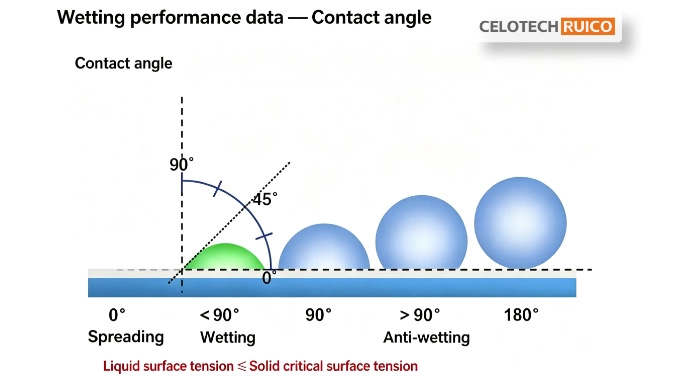
During the coating application, the liquid phase must contact the substrate surface or pigment particles first. But many surfaces are difficult to wet because of low surface energy. Hence, the coating cannot spread evenly, leading to application issues.
Better wetting enables the liquid phase to establish more effective contact with solid surfaces, improving surface coverage and the uniformity of film formation. During the initial dispersion process, wetting agents can also help the liquid phase penetrate and cover pigment surfaces more efficiently. So you can get smoother processing and a better coating appearance.
With adequate wetting, your coating often has better leveling, fewer surface defects and more consistent performance.
Factors to Consider When Selecting a Wetting Agent
Though wetting agents are helpful, there is no fixed wetting agent type or grade for every coating system. When selecting a wetting agent for a waterborne coating, you should consider the following factors:
Binder Chemistry
Different binder systems like acrylic, styrene-acrylic, and SBR latex may not respond the same way to the same additive. You should evaluate the compatibility between the wetting agent and the binder.
Pigment and Filler Loading
Pigment and filler loading defines different wetting demands. If your formulation has high levels of TiO₂, calcium carbonate or other fillers, it requires more surface-active additives. Inadequate pigment wetting may cause poor incorporation, floating, flocculation, etc.
Substrate
You should also choose different wetting agents for different substrates. A wetting agent that performs well on concrete may perform poorly on wood surfaces.
Application Method
You should evaluate different application methods since brush, roller, or spray will introduce different shear and surface-flow conditions.
Surface Tension
You are also supposed to avoid excessive surface tension, which can cause new problems, such as foam, poor repeatability or water resistance.
Dosage of Wetting Agent
There isn’t a universal dosage of wetting agents for every coating system. You should evaluate based on active content, binder system, pigment loading and target performance.
The typical dosage range of liquid wetting agent in water-based coating is about 0.1-1.0% of the total formulation. For a practical approach, you can prepare several otherwise identical formulations in that range and compare them. Adjust and work out the optimum dosage based on different wetting performance, surface appearance, stability and so on.
Remember that your goal is not to maximize wetting, but to find the best balance with the lowest effective dosage.
Example Wetting Agent Formulation for Water-Based Exterior Paint
As mentioned above, the wetting dosage will vary across different water-based coating systems, the formulation will also not be fixed. For your reference, we will take a wetting agent formulation in exterior paint as an example. Here is an illustrative starting formulation for laboratory screening, and you need to adjust accordingly.
| Component | Starting Level (%) |
| Water, initial | 18.0 |
| Dispersant | 0.5 |
| Wetting agent | 0.3 |
| Defoamer | 0.2 |
| TiO₂ | 10.0 |
| CaCO₃ | 15.0 |
| Other fillers | 10.0 |
| Acrylic emulsion | 25.0 |
| Coalescent | 1.5 |
| Thickener | 0.4 |
| Other additives | 1.1 |
| Water, final adjustment | 18.0 |
| Total | 100.0 |
As it is not a universal commercial formula, we suggest you use it as a laboratory framework and adjust the levels according to your binder, pigment system and final finish requirements.

Wetting Agent vs Dispersing Agent
Wetting agents and dispersing agents are two different chemical additives, but they are closely related.
As explained in the previous paragraph, the function of wetting agents is to help the aqueous phase spread over the pigment surface. They can replace the air or other poorly wetting interfaces around the particles, but cannot stabilize pigment particles. Dispersing agents take over this job after the pigment has been wetted. They can adsorb onto the pigment surface and help keep the particles separated and stabilized in your coating.
Thus, you can find that wetting and dispersion are related but distinct steps. If your coating has poor initial substrate coverage, a wetting agent may be part of the solution. If pigment particles are flocculating or settling, you may not solve the problem by simply using a wetting agent. Perhaps you need to consider a dispersant then.
In a word, you can not think of replacing a wetting agent with a dispersant.
Interaction with Other Coating Additives
A wetting agent is only one of the components in a coating formulation and does not work independently. Its surface activity can also influence the performance of other additives. Therefore, you should evaluate based on the formulation system when choosing a wetting agent and pay attention to the formulation balance.
Wetting Agent and Defoamer
Wetting agents and defoaming agents often performe interconnected because they both act at interfaces. A highly surface-active wetting agent may cause much foam, particularly under high-shear mixing. If you choose an incompatible defoamer, the foam will reduce wetting efficiency or create surface defects. You need to evaluate the defoaming agent together to get a balance between wetting and foam control.
Wetting Agent and Thickener
In a water-based coating system, the wetting agent can sometimes influence the behavior of rheology modifiers too. Especially affect the associative thickeners, as they work by interactions within the liquid phase. If the surfactant concentration changes, the viscosity, flow behavior and application properties may be affected. Therefore, you should reassess the rheological performance if there are changes to the wetting agent.
Wetting Agent and Leveling Agent
Leveling agents contribute to surface behavior after application similar to wetting agents. While wetting agents help the coating establish contact with the substrate, leveling agents help control film flow and surface appearance. The relationship of these two coating additives can influence film smoothness and gloss development. They work together to control defects, so you should test their compatibility as an important part of the formulation optimization as well.
A Practical Workflow for Wetting Agent Formulation
To help you evaluate wetting agents more efficiently and avoid other problems after optimizing one, we will guide you through a systematic workflow. You can assess it step by step under conditions that represent the final coating application.
1. Define the Formulation System
You can start from identity the binder type, pigment and filler loading, substrate, etc. Combine this with your application method and key performance requirements, and you can determine the desired effects of wetting agents.
2. Select Suitable Wetting Agent Chemistry
You should choose the materials based on their compatibility with the binder and other additives. Required surface activity, foam tendency, and intended application are also your considerations. In different coating systems, you need to apply different wetting agents.
3. Establish a Dosage Ladder
To achieve the optimal dosage of wetting agent in your coating formulation, you can attempt to test several dosage levels. Remember to keep the rest of the formulation unchanged during testing. For example, compare 0.1%, 0.4%, 0.7%, and 1.0% of the total formulation within the recommended range. Once the effective range has been identified, you can make finer adjustments to determine the optimum dosage.
4. Evaluate Primary Wetting Performance
You should assess the properties directly related to wetting first. You can check substrate coverage, spreading, pigment incorporation, and surface appearance. And also to check how efficiently difficult-to-wet pigments or fillers become wetted during dispersion. Use the same application and testing conditions for every sample.
5. Evaluate Secondary Properties
Once you have confirmed the basic wetting performance, examine its effect on the rest of the formulation. Check foam generation, viscosity, leveling, gloss, water resistance, recoatability and other application properties. You should keep the overall formulation balance after improved wetting.
6. Check Storage and Aged Performance
Testing on fresh samples is not enough. You should repeat key evaluations after storage or film aging. You should check if there are changes in viscosity, phase stability, surface appearance, water resistance and other properties. Some compatibility effects may only become visible over time.
7. Select the Lowest Effective Level
The best dosage is not to provide the strongest initial wetting effect. If it can offer you require wetting performance and does not affect other coating properties, it can be enough. The best addition level is always in the condition of good balance between wetting, stability and application performance.
Compared with choosing a product from a single laboratory result, these steps can help you choose a more reliable wetting agent solution. It can also help you to trace and repeat the formulation adjustments during mass production.
 Final Thoughts
A successful wetting-agent formulation in water-based coatings depends not only on additive selection, but also on dosage optimization, compatibility evaluation and formulation balance.
Celotech Ruico has designed various grades and types of wetting agents and can help you optimize additive combinations and develop more reliable coating formulations.
FAQ
Can a Wetting Agent Improve Adhesion?
Not directly. Adhesion depends primarily on the binder system and substrate condition, but better wetting can be helpful to adhesion development.
Does Every Water-Based Coating Need a Wetting Agent?
Not always. If the existing surfactant package in the formulation has sufficient wetting, no need for an additional wetting agent. If the substrates, pigments or fillers are hard to wet, you should consider a wetting agent.
Do Wetting Agents Affect Drying Time?
No, drying performance is generally controlled by the binder, coalescent and environmental conditions.
Should Wetting Agents Be Added During the Grind Stage or Let-Down Stage?
It depends. You can share your formulation information with us and our experts will share professional guidance.
Can Wetting Agents Improve Edge Coverage?
Together with rheology modifiers, wetting agents can sometimes help improve coating coverage in difficult areas.