In water-based paint and coating formulations, the proportion of additives is not high, but their impact on the final product can be much greater than you might think. Different products and applications have different additive requirements.
Why Add Additives to Paints and Coatings
Coatings and paints include resins, pigments, solvents or water, and various additives. Resins form the film, pigments provide color and covering power, and additives focus on solving specific formulation problems. For example:
- Paints and coatings are prone to sedimentation during storage, so the dispersion and stability effects need to be considered;
- During the production process, there are often a lot of bubbles, so appropriate defoamers are needed to eliminate the bubbles;
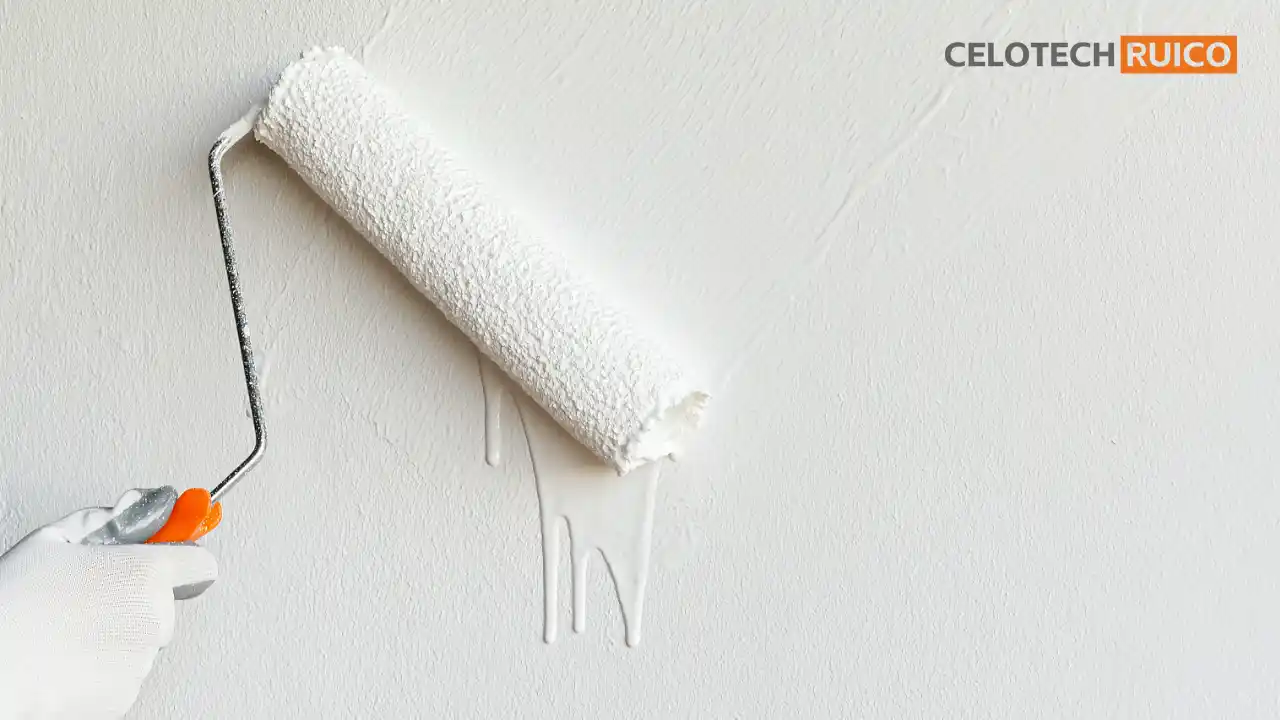
- During construction, if there are defects such as pinholes, orange peel, or poor leveling, it may be necessary to start with the wetting agent or leveling agent.
From this, it can be concluded that the most important value of paint additives is not simply “improving performance,” but helping the formulation solve problems that basic raw materials themselves cannot solve.
What Are the Common Additives Used in Paints and Coatings?
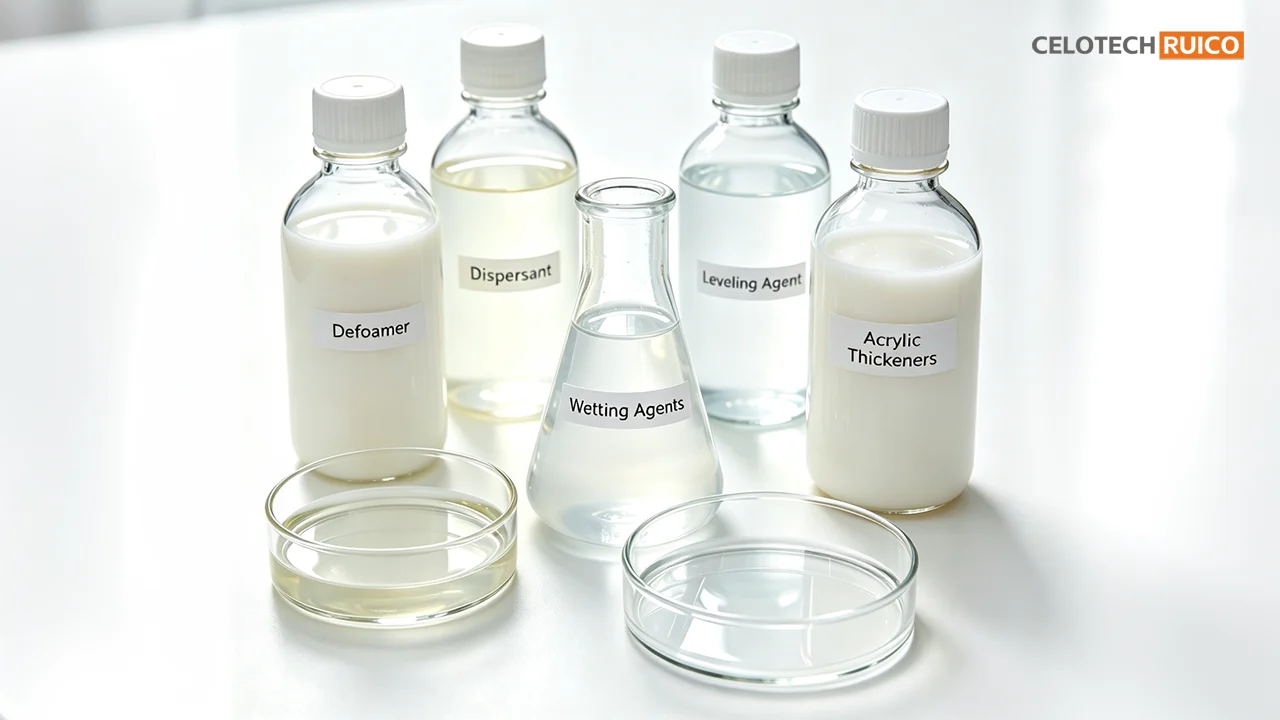
Different additives serve different functions and have different applications.
Defoamer
If you produce water-based paints or coatings, you are likely familiar with foam.
During the production processes such as high-speed dispersion, stirring, conveying, and filling, air may be introduced into the products. If foam is not controlled, it can affect production efficiency and may cause surface problems such as pinholes in the final coating.
Defoamers can help reduce this foam. However, when choosing a defoamer, do not only consider “whether it is fast enough to eliminate the foam,” but also consider the compatibility of the defoamer with the formulation or the addition amount. If it is too high, it may also cause pinholes, surface unevenness, and other new problems.
Dispersant
The dispersant is used to help the pigments and fillers remain uniformly dispersed in paints and coatings. Color instability, reduced tinting strength, sedimentation, and flocculation may all be related to the dispersion state.
It should be noted that if you find that the product’s viscosity is insufficient, do not keep increasing the thickening agent. It may be that the pigments are not dispersed properly. Increasing the thickening agent cannot solve the fundamental problem.
Therefore, when you notice abnormalities in color, sedimentation, or storage stability, first check the dispersion. It is often more reasonable to check dispersion first than to adjust viscosity directly.
Wetting Agents
Wetting agents primarily facilitate the wetting of pigments, fillers, and substrate surfaces by the liquid coating. If pigments are difficult to wet, or if issues such as uneven coverage or localized surface defects arise after application, it is advisable to first assess the wetting performance.
Wetting performance also influences the final surface quality of the coating. Therefore, an uneven coating surface is not necessarily caused by the leveling agent; sometimes, the issue does not originate at the leveling stage but stems from inadequate wetting of the pigments or the substrate.
Leveling Agent
Leveling agents are mainly used to improve the surface condition of paints and coatings after application, helping the coatings spread more evenly and reducing surface defects such as pinholes and orange peel texture, making the paint film look more beautiful and smooth.
It should be noted that leveling agents are not directly interchangeable between different formulations. The same product may perform very well in one formulation but behave completely differently in another. Therefore, when choosing, one also needs to consider whether it is compatible with the resin, other additives, and the construction conditions.
Acrylic Thickeners
Acrylic thickener is mainly used for viscosity regulation and rheological control in water-based paints and coatings.
It can help improve viscosity, anti-sagging properties, construction performance, and storage stability. For water-based systems such as architectural coatings, acrylic thickener is a common choice.
In addition, when choosing a thickener, it is not only about the final viscosity. Two products may both achieve the same viscosity, but may exhibit completely different construction feel and leveling effects.
Polyurethane Thickeners
Polyurethane thickening agents (PU thickeners) can also help adjust viscosity and rheological properties. In formulations that require a balance of viscosity, fluidity, leveling, and construction feel, PU thickening agents can provide rheological performance different from traditional thickening agents.
Rheology Modifiers
Rheology modifiers are mainly used to control the flow behavior of paint and coatings during storage, mixing, and application. They not only increase viscosity but also help your products improve anti-sagging, leveling, construction feel, and storage stability.
When choosing rheology modifiers, do not just focus on a single viscosity number. You should pay more attention to the overall performance of the paint in actual use. For different formulations such as architectural coatings and industrial coatings, you also need to select appropriate rheology modifiers based on specific performance requirements.
Other Special Functional Additives
In addition to the above categories, some paints and coatings will use other functional additives according to specific purposes, such as preservatives, antibacterial agents, opacifying additives, anti-settling additives, etc.
Not every paint and coating requires these products. Ultimately, it depends on your formula, where the product is used, and what problems you want to solve.
How to Choose the Right Additives for Your Formulation?
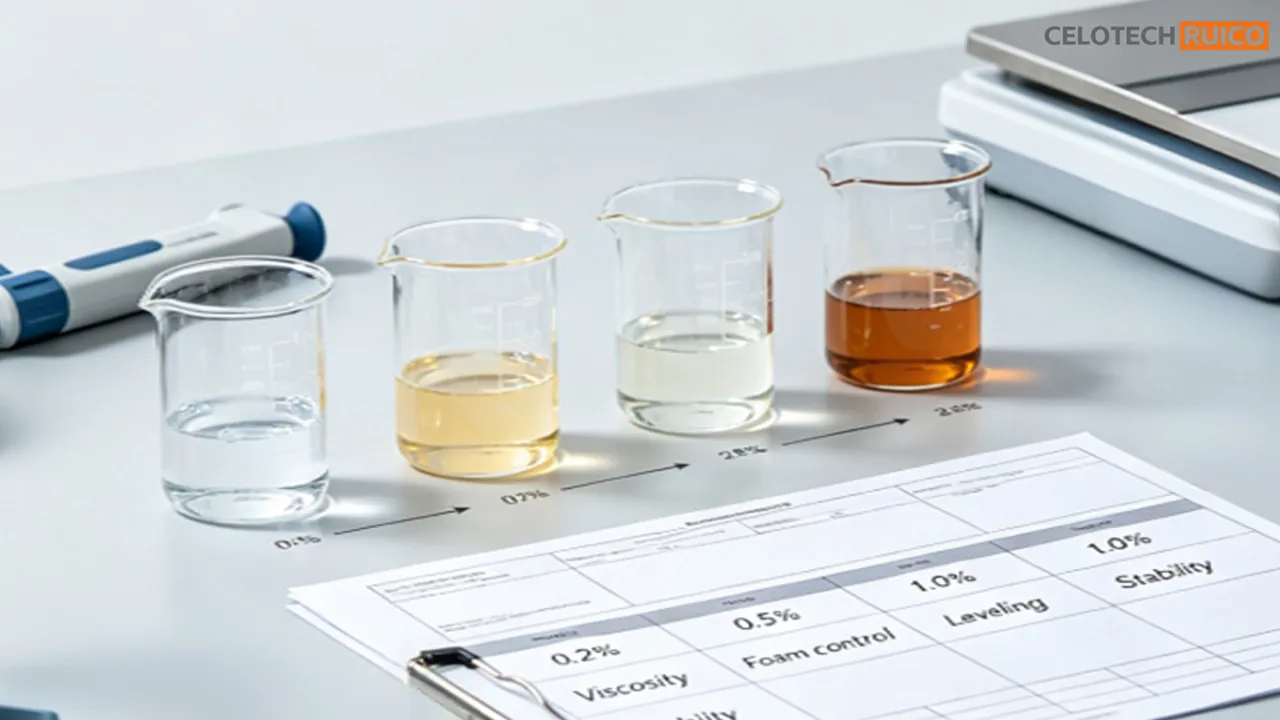
If you don’t know where to start, here are some questions to consider. What Is the Specific Problem You Are Facing Now?
- Is there too much foam?
- Is the pigment dispersion not good? l Slow wetting speed?
- Poor leveling?
- Too low viscosity?
- Also prone to run-off after application?
Only by identifying the problem can you more accurately find the corresponding additive.
Choosing the Appropriate Resin Type
The resin significantly impacts additive selection. Different resin types, such as pure acrylic, styrene acrylic, SBR, VAE, etc., may react differently to the same additive.
Therefore, if you want to test a new additive, it is best to directly use the resin you use in actual production for testing.
Consider the Influence of Pigments and Fillers
The type of pigments and fillers will significantly affect dispersion and viscosity. If you change the pigment supplier or the amount of fillers, you may also need to adjust the amount of additives you add.
This is why an additive that performs well in someone else’s formula does not necessarily mean it will be effective when directly added to your formula.
Determine the Product Application Method
Consider how the end customer will use this product. Will it be brushed, rolled, or sprayed?
Different application methods may require different levels of viscosity, fluidity, defoaming, and leveling. A paint that is very suitable for spraying may not be equally suitable for rolling. Therefore, when choosing additives, consider the actual application method.
Add an Appropriate Amount of Additives
It is difficult to establish a uniform addition ratio for all paints and coatings. Usually, the recommended addition amounts provided by suppliers are better as a starting point for your tests than as a final ratio that must be strictly followed.
For example, you can start with a lower addition amount and gradually increase it while observing the viscosity, foam, leveling, storage stability, and final coating effect. You may find that increasing from 0.2% to 0.5% significantly improves product performance, but increasing further to 1% offers very little improvement.
Sometimes, using too much addition can even cause new problems. So you need to find not the maximum addition amount, but a reasonable amount that achieves the desired effect. This not only helps control costs but also supports product stability.
Combined Use of Additives
In fact, most paint and coating formulations use multiple additives simultaneously. For example, a water-based paint might use defoamers, dispersants, wetting agents, acrylic thickening agents, and polyurethane thickening agents.
However, this does not mean that adding each additive will always improve the product. Different additives can interact with each other.
For instance, a defoamer might affect surface effects; a wetting agent might affect foam; and different thickening agents combined might also change leveling and construction feel.
Therefore, if you are developing a new formula, it is best not to change many things at once. Adjusting one key variable at a time makes it easier to find a truly effective solution.
Quick-Reference Chart for Coatings and Paint Additives
| Formulation Problem | Additives to Consider | Typical Starting Dosage Range | Main Function |
| Excessive foaming | Defoamers | 0.1–1.0% | Control foam and air entrapment. |
| Poor pigment dispersion | Dispersing Agents | 0.5–3.0% | Improve pigment dispersion and stability. |
| Poor substrate wetting | Wetting Agents | 0.1–1.0% | Improve wetting and spreading. |
| Poor surface leveling | Leveling Agents | 0.1–1.0% | Improve flow and surface leveling. |
| Low viscosity | Acrylic Thickeners / PU Thickeners | 0.1–2.0% | Adjust viscosity and rheological properties. |
| Poor sag resistance | Thickeners / Rheology Modifiers | 0.1–2.0% | Improve application and film-building properties. |
| Poor storage stability | Dispersing Agents / Thickeners | 0.1–3.0% | Improve formulation stability. |
| Poor application performance | Rheology Modifiers | 0.1–2.0% | Adjust flow and application properties. |
Note: Typical starting dosage ranges are provided for formulation development only. Actual dosage depends on the specific additive, binder system, pigment and filler loading, and target performance. Determine final dosage through formulation testing.
Common Mistakes When Choosing Paints and Coatings Additives
Only Looking at the Price
Price is important, especially when you need to purchase a large quantity of additives. But a low price does not necessarily mean a lower final cost.
If a cheap additive requires a higher addition amount or causes production instability and increased defects in the finished product, the actual cost may be higher.
Over-reliance on Technical Parameters
The parameters on the TDS are important, but they don’t tell you everything. Even if a product has good technical indicators, it may not perform well when added to your actual formula. Therefore, in addition to looking at product data, you also need to conduct actual formula tests.
Thinking That More Additives Are Always Better
This is a very common misconception. Just because adding a little bit of an additive can improve performance doesn’t mean that increasing the amount will always lead to better results.
Excessive addition may cause compatibility issues, surface defects, and viscosity changes, and also increase costs.
Ignoring Actual Construction Conditions
Your paint performs well in the laboratory, but that doesn’t mean the customer’s site will always yield the same result. Temperature, humidity, substrate, construction tools, and drying conditions can all affect the final effect. Therefore, if conditions permit, it is best to conduct tests in the customer’s actual operating environment.
FAQs
Are Paint Additives and Coating Additives the Same?
Most of the types of additives used are the same, but when using the same type of additives, the models and addition amounts required for different products may also vary.
How to Test a New Paint Additive?
You can conduct a small-scale test first, set different addition amounts for comparison, and then observe the viscosity, defoaming, leveling, construction feel, storage stability, and final coating effect.
Do Coating Additives Affect the Gloss of the Coating?
Yes. Especially defoamers, leveling agents, wetting agents, and some dispersants may all have an impact on the final gloss. If your product has specific requirements for a high-gloss or matte finish, you need to assess the effect of additives on gloss in the actual formulation.
Is the Order of Adding Coating Additives Important?
Yes, it is. Some additives are suitable to be added during the dispersion stage, while others are better added later. If the addition order is inappropriate, it may affect dispersion, defoaming, thickening, or the final surface effect. Therefore, in addition to choosing the appropriate products, you should also pay attention to the recommended addition process.
Should You Replace the Leveling Agent When There Are Brush Marks on the Coating?
Not necessarily. Brush marks may be related to the leveling agent, or they could be caused by viscosity, construction method, or drying speed. It is recommended to first identify the real cause before deciding whether to adjust the leveling agent.
Why Does the Coating Work Well When It Is Freshly Produced But Starts to Have Problems After a Few Days?
Some problems do not occur immediately, such as sedimentation, viscosity changes, or stratification. In addition to checking the production process, you should also observe the changes in the formula after storage for different periods of time to accurately determine the source of the problem.
What Kind of Help Can Suppliers Provide for the Selection of Coating Additives?
A good supplier does not just provide a product name. You can explain to the supplier your formula type, the problems encountered, and the target performance, and let them recommend products and testing directions based on the actual situation. This is usually more effective than simply comparing product prices.
Final Thoughts

The key point in choosing paint and coating additives is whether the product suits your formula, production process, and the final customers’ usage requirements.
Celotech Ruico offers a variety of additives for paints and coatings, including defoamers, dispersants, wetting agents, acrylic thickeners, etc. We can tailor solutions for you based on your specific application to enhance performance and reduce costs. Please feel free to contact us.